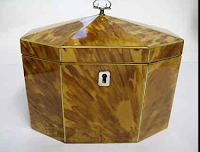
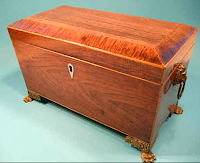
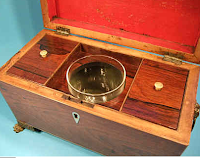
An Etui (pronounced a-twee) is a pocket-sized ornamental case dating from the 18th to 19th century. These cases were made of different materials, such as silver, gold, enamel, gilt metal and tortoiseshell.


Rococo (pronouned roh-cocoa) Revival was an effort during the early to mid-Victorian period (around 1845-1870) to revive the Rococo Louis XV style that had originated in France in the early 18th century; however, the 19th century Revival has much more exaggerated curves and intricate and realistic carved ornamentation.
One of the most famous makers of Rococo Revival for the luxury market was German-born John Henry Belter of New York City. Belter (1804-1863) created elaborate lacy pieces from laminated rosewood panels using a technique that he patented. Several layers of wood were glued together in alternating directions to give it strength, and the panels were then steamed under pressure in molds to produce curves. After that, the furniture components were carved in intricate patterns of scrolls, fruit, and flowers (source: Kovel’s On Antiques and Collecting). Belter was famous for his large and exuberant parlor room sofas, which are embellished with bouquets of naturalistic blooms.
Image 1 below, from the Metropolitan Museum of Art, is a superb example of Belter's high-end sofas.

Image 1
Another company, J. and J.W. Meeks, also of New York, made similarly ornate pieces. See image 2 of a pair of walnut chairs by Meeks, circa 1850 (image courtesy of Timeless Antiques, Laguna Beach, CA).

Image 2
Other notable markers of this style were Alexander Roux, Charles Baudouine, Leon Marcotte, and Ignatiius Lutz.
DID YOU KNOW that most of the Rococo Revival furniture were pieces designed for the parlor (rather than, say, for the dining area or library)? The curved, often pierced carved wood pieces appeared more "feminine" and therefore were more conducive to the parlor - the "domain" of the lady of the house.
Most silver articles made in the United States before around 1860, when the sterling silver standard was accepted, are referred to as "coin."
Coin silver has a slightly higher silver content than sterling silver. Pure silver is too soft for normal use and has to be alloyed, usually with copper and other trace elements. Sterling is 925 parts silver per 1000 parts, and American coin silver has a lower percentage: from 1792 to 1837, it was .892; thereafter, .900. Other countries may use the words “coin silver” to mean the purity used in their silver coins, which may be different from US coins.
In America’s colonial days, coin silver was literally made from melted-down coins. Between about 1830 and 1860 silver was often marked “Coin,” “Pure Coin” or “Dollar” to show that the piece was the same quality as coins. (Source: Kovels On Antiques and Collectibles).


Cut glass is art glass with a design made by cutting or grinding the surface, and brilliant cut glass are objects with elaborate deeply cut patterns that usually cover the entire surface and are highly polished.
The Brilliant Period in glass (1876 - 1910) began with the 1876 Centennial Exposition in Philadelphia, PA where, thanks to new rail transportation, record numbers of people attended and were captivated by the elegant cut glass tableware, lamps, perfume bottles and other fine products on display. While previously Europe’s fine glass was in vogue, a boom was sparked in the US for glass furnaces to sprout throughout the Northeast.
Patterns quite unlike earlier European designs were developed, and patterns were given intriguing names, such as Hobstar, Pinwheel, Button Bull’s-Eye, Strawberry Diamond Vesica, Crosshatch, etc. (source: American Cut Glass Association)
An example of a sought-after shape in American Brilliant cut glass is this footed, three-handled loving cup made by The Libbey Glass Co., generally considered today to have made the best cut and faceted glass during the brilliant period. (Image courtesy of The House of Brilliant Glass, www.brilliantglass.com).